Designing a scalable landing page system that adapts to user intent
I created a repeatable landing page system that helped our team launch campaigns faster, match experiences to different stages of awareness, and continuously improve performance through A/B testing.
Duration
Product / CRO Web Designer
Tools
Figma • Replo • GA4
Process
UX Strategy • CRO • Testing
50+
Campaigns
60+
A/B tests
1-2
Landing pages/week

The Problem
Scaling landing pages for a growing paid social strategy
As Cymbiotika expanded paid social campaigns, our team needed to launch 1–2 landing pages each week for users with different levels of awareness and purchase intent.
The Challenge
Different users were getting the same experience
Users entered from different campaigns with different needs, but many were sent to the same product experience. We needed to better match the experience to user intent without designing every page from scratch.
Match content to intent - Adapt the experience based on what users already know.
Build faster and consistently - Use reusable sections instead of starting from scratch.
Continuously improve - Design for ongoing A/B testing and iteration.
Research Process
The Challenge
Different users were getting the same experience
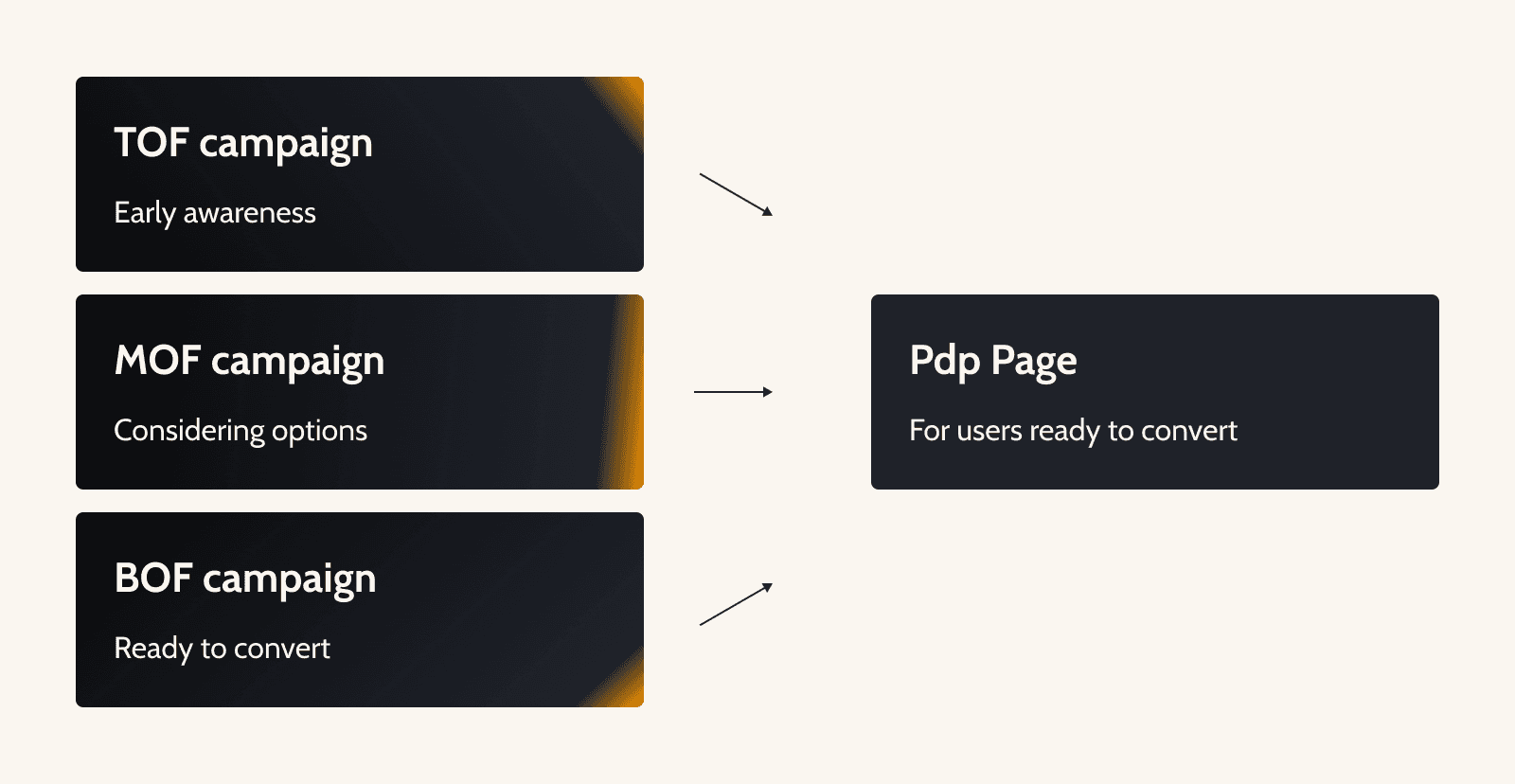
Our campaigns reached users with different levels of product awareness and purchase intent, but many were sent to the same product experience (pdp page). At the same time, our team needed to launch 1–2 landing pages each week without designing every campaign from scratch.
Different Intent → Same Experience (bad!)
🧐
How might we create landing pages that adapt to user intent while remaining fast to build, test, and improve?
Research
Understanding what users needed before purchasing
I reviewed audience data, campaign behavior, heatmaps, session recordings, and existing landing pages to understand what information helped users move toward a purchase.
Benefit-first messaging
Users needed to quickly understand why the product mattered to them.
Easy-to-scan content
Clear headlines, visuals, and shorter sections helped users understand the page without reading everything.
Different levels of awareness
Someone discovering a product needed a different experience than someone already considering a purchase.
Literature Review
Different Funnel Stages Need Different Experiences
Users at different stages of awareness need different information to feel confident moving forward.
🧐
How might we create landing pages that adapt to user intent while remaining fast to build, test, and improve?

Design Strategy & Process
Design Strategy
Three principles guided the landing page system
These insights became the foundation for how I designed and scaled landing page experiences.
Match content to intent
Adjust messaging, education, and proof based on how familiar users are with the product.
Design for speed + consistency
Create reusable sections that can be combined across campaigns instead of rebuilding every page from scratch.
Design for experimentation
Build flexible experiences that make it easy to test, learn, and continuously improve.
Design for speed + consistency
Reusable sections made it easier to create different landing pages.
I created variations of key sections, such as value propositions, product education, and supporting content, that address user needs at different funnel stages. These modular sections can be combined and adapted per campaign instead of designing each page from scratch.

Progressive Disclosure
Show simple information first, then introduce more detail as users continue.
Scannable hierarchy
Clear headlines, visuals, and shorter sections helped users understand the page without reading everything.
Scannable hierarchy
Remove unnecessary complexity so the experience feels easier to process.
Mobile rhythm
Use consistent spacing and section patterns to make scrolling feel clear and predictable.
Case Example • Top of Funnel
Simplifying the experience for users still learning about the product
The original TOF listicle was content-heavy and didn’t fully align with our lower-awareness funnel strategy. I restructured the page to reduce cognitive load, improve scannability, and guide users through information progressively.
🧐
Key UX Principles: Progressive disclosure · Scannable hierarchy · Reduced cognitive load · Mobile rhythm

Impact
A faster system that continued improving through experimentation
The system helped our team support a high volume of campaigns while creating more intentional experiences for users at different stages of the funnel.
50+
Campaigns designed and launched
60+
A/B Tests designed and evaluated
1-2
Landing Pages / Week increased production capacity

Impact
A faster system that continued improving through experimentation
The system helped our team support a high volume of campaigns while creating more intentional experiences for users at different stages of the funnel.
50+
Campaigns designed and launched
60+
A/B Tests designed and evaluated
Why it Mattered
The system created more time for optimization instead of repeatedly solving the same design problems.
Collaboration
Designing within a cross-functional growth team
I partnered with Growth to understand campaign goals, R&D to validate product and scientific claims, Creative to align imagery and brand direction, and Development to bring each experience to production.

Design Strategy
Three principles guided the landing page system
These insights became the foundation for how I designed and scaled landing page experiences.
Benefit-first messaging
Users needed to quickly understand why the product mattered to them.
Easy-to-scan content
Clear headlines, visuals, and shorter sections helped users understand the page without reading everything.
Different levels of awareness
Someone discovering a product needed a different experience than someone already considering a purchase.
This project changed how I approach CRO design. Instead of thinking only about individual pages, I now think about the system that allows experiences to continuously evolve.